
Heritage in design is either a velvet rope or a velvet coffin. Done well, it keeps the soul alive while giving the brand room to evolve.
Liberty London has been balancing this since Arthur Liberty founded the business in 1875. It built its reputation importing silk and textiles from Asia and the Middle East before becoming synonymous with the Arts and Crafts movement through designers including William Morris.
Today, that legacy sits inside an archive estimated to contain more than 50,000 print designs, although even Liberty’s own archivists admit nobody knows the exact number because patterns have been continually reworked, recoloured, resized and revived rather than filed away and forgotten. They’ve never been treated as museum pieces.
Art Nouveau motifs from the 1880s resurfaced during the Gothic Revival of the 1970s, while Aesthetic Movement sunflower prints found a new audience on Carnaby Street in the 1960s.
Pentagram recognised the same opportunity when it rebranded Liberty in 2020 before carrying that thinking into LBTY.
The name comes from Liberty’s historic signage. Harry Pearce built the identity around the abbreviation because it allowed a 150-year-old name to sit naturally on a modern beauty shelf without losing sight of where it came from.

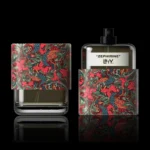
Pentagram’s industrial design team wanted a distinctive fragrance bottle without commissioning bespoke glass tooling, normally the biggest expense in a fragrance launch. Their answer was an oversized cap wrapping around almost the entire bottle, covering the label and creating the largest printable surface on the pack.
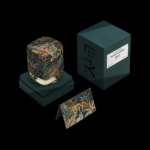
Every fragrance carries its own Liberty archive print, turning the pattern into part of the product. Deep, colour-saturated uncoated paper, a foiled LBTY logotype and carefully judged detailing. Tudor, Zephirine, Wild Rosinda, Liberty Maze and Adelphi Sun each have their own archive pattern and box colour, creating five distinct interpretations from the same archive instead of repeating one heritage motif.
Pentagram always intended the design language to extend beyond fragrance into future categories. That long-term thinking gives LBTY room to grow without reinventing itself every time a new product appears.
Is heritage a constraint or the most creative asset you’ve got?