Museums
‘I am the walrus’: Anatomy’s charming new identity for the Horniman Museum
I struggle to think of a subculture I detest quite as viscerally and deeply as steampunks: not only is it aesthetically quite hideous, I just don’t really get it – it’s the past! But the future! But very dusty and everyone’s a creep! Inexplicably wearing goggles! It all smacks of a man in the corner of your front room at...
Porto Rocha creates bold yet sensitive new identity for Brazilian art gallery Almeida & Dale
Founded in São Paulo in 1998, Almeida & Dale is a Brazilian art gallery specialising in modern and contemporary art. Over the past 20 years or so, across its three galleries in Brazil it has developed a programme of exhibitions, publications and art fairs, representing artists and estates spanning different periods and movements in Brazilian art – including Lygia Clark,...
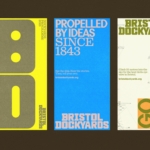
How & How takes a smart, bright collage-based approach to overhauling Bristol Dockyards
For those outside of Bristol, it’s all too easy to assume that the city is merely a place where Triphop and Dubstep were born; a Mecca for trustafarian types on a perennial ‘gap yahhh’ wearing those trousers that make people look as if they’ve had some sort of toilet issue; a place where the streets are paved with ketamine and...
Who knew a spiral could do so much? Pentagram did, in this joyful Tokyo museum identity
The Museum of Narratives (also known as MoN Takanawa) is located in Tokyo’s Takanawa Gateway City, and opened a couple of months ago in March 2026. It’s something of an experimental museum with a cross-disciplinary programme spanning visual art, installations, and performances themed around everything from society to art to science, manga, and anime; merging traditional Japanese culture with hyper-modern,...
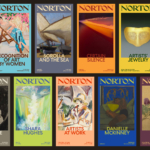
Koto breathes new life into Floridian arts institution The Norton
The Norton Museum of Art began life in 1941 in West Palm Beach, Florida, and in the near-century since, its whole raison d’être has been based around its role as a place where “art and life meet as a part of everyday art”. As such, it acts as more than a look-don’t-touch-style gallery space: the garden, gallery and restaurant are...
Off-kilter and elevated
St Paul’s Cathedral is undoubtedly one of the most iconic, recognisable landmarks of London’s skyline: its vast dome, all beautiful copper-tarnished turquoise, resplendent with dazzlingly golden pineapples (one of its architect Sir Christopher Wren’s favourite accoutrements, and back in the 17th century a distinct status symbol representing all that was bountiful and exotic). Until 1963, St Paul’s was the tallest...
Kanal by Base Design
Kanal is a museum-to-be with an admirable yet bold raison d’être that defies much of what we think we know about the nature of highbrow cultural sites: not a “finished institution, but a cultural project in motion,” as its general director Yves Goldstein puts it. Based in Brussels, Kanal will – somewhat surprisingly – become the city’s only museum of...
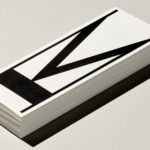
Kunsthalle Basel by Porto Rocha
Basel is a fascinating place – beautiful but unassuming, relatively small but the undisputed capital of the contemporary art world. Not only is it the host of – as you’d guess from the name – Art Basel, the Art Fair that arguably forms the pinnacle of the global art market calendar, but it also has one of the highest densities...
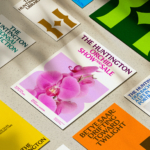
The Huntington by Base Design
There’s a particular kind of challenge that crops up again and again in cultural branding – not obscurity exactly, but partial recognition. The sort where an institution is famous for one thing, quietly exceptional at several others, and yet rarely understood as a coherent whole. The Huntington, a century-old cultural and research institution in Southern California, sits squarely in that...
Philadelphia Art Museum by Gretel
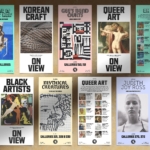
Creating museum and gallery identities must be both a dream brief and an intimidating prospect for brand designers; a poisoned chalice of sorts. We hear the same challenges time and again when agencies discuss such projects: creating a brand that’s both strong and ownable but which lets the artefacts/art take centre stage; an identity that takes an institution into the...
ROM by Leo Burnett
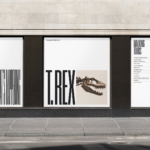
Okay, let’s get it out of the way… yes, there are elements of Pentagram’s 2018 Library of Congress in Leo Burnett’s work for the Royal Ontario Museum (ROM). In both projects, type is a frame for images of archive material. Is it BP&O’s responsibility to acknowledge similarities in all the work we publish, tracking a typology back to the start...
National Portrait Gallery by Edit Brand Studio
In June 2023, a giant of British cultural life awoke from a three year slumber. The return of the National Portrait Gallery evokes a joy that is made all the keener when one recalls the troubled time in which it closed its doors: March 2020, as the COVID-19 pandemic took hold and public life evaporated in the announcement of that...